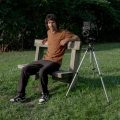
Old Brooklyn had reached a crossroads when Brendan Zak joined its community development board in 2021.
Its biggest redevelopment proposal had stalled. Plans to knock down the long-vacant St. Luke’s Church to make way for apartments had run into community resistance and been rejected for state low-income housing tax credits. The organization was forced back to the drawing board.
[This story was updated to correct the type of tax credits developers had applied for.]
It was a turning point for Brendan, too. He was in the midst of painstaking renovations on his first house in Old Brooklyn, a DIY project that often felt like it would never end.
As an adult, Brendan had chosen to move back to the neighborhood where he spent his early childhood. For decades, he told me, Old Brooklyn had felt “frozen in time.”
Fast-forward to this summer, when Brendan and his husband Joey led me on a photowalk through their neighborhood. We passed St. Luke’s, originally built in 1903, now surrounded by bright orange barricades and construction fencing.
The project was finally moving forward, though in a very different form this time around.
“It’s just interesting to watch the neighborhood kind of transform,” Brendan said. “Old Brooklyn has just kind of been still for 50 years. It’s kind of been the same neighborhood for 50 years.”


The Memphis & Pearl project, as it has been called, will now incorporate the sanctuaries of both St. Luke’s and the adjacent Pearl Road United Methodist Church into a mixed-use building with apartments, retail storefronts and a patch of greenspace.
The nearby Greenline building, an iconic triangular retail building right on the street corner, has already been demolished in the weeks since we photographed it. That and the demolition of St. Luke’s school annex have prompted some pushback, but the community reception has been warmer than it was back in 2021.
Talking with Brendan, I got the sense that the Memphis & Pearl project may mean more to him as an Old Brooklyn resident than as a community development board member.
As we walked along the duck pond at the The Cleveland Winery and Animal Sanctuary off Memphis Avenue, Brendan told me about how he ended up back in Old Brooklyn. He’d been looking at homes elsewhere in the city and inner-ring suburbs, but he mostly saw too little house for too much money.
Old Brooklyn was different. Here, his attention fell on house after house in the midst of renovations. Many that initially seemed doomed began to look unrecognizable, in a good way.
So, when Brendan signed papers for his first house in Old Brooklyn, he told me: “We very purposely bought the worst house on the street.”
Care can be infectious like that. From my view, buying and fixing up that house was not only about the personal milestone of becoming a homeowner. Brendan didn’t want to see a vacant lot where a lived-in, cared-for house could be.
He spent a few years’ worth of weekends banging his head against the walls of that house. It needed just about everything a rehab could need. When it was finally done, he said, “never again.”


With my last photowalk in Detroit Shoreway fresh in my memory, hearing Brendan reflect on Old Brooklyn’s relative stillness struck me. For one reason or another, financial crises, suburban flight and the housing crash have all played out very differently here than they did just a handful of miles north. So, too, has reinvestment.
“You could buy a house on this street for 150 to 200 grand still,” Brendan said, pointing toward a residential street off Memphis Avenue.
“We still have all of the old historic homes where we literally don’t have room to build the new, like, gentrifying housing. I’m not gonna lie to you and say property values haven’t increased in the last five or 10 years, they absolutely have. But it feels a lot more, almost, sustainable.”


It might be that Old Brooklyn’s geography has a hand in its unique development. The neighborhood juts south of Clark-Fulton, sandwiched between Cuyahoga Heights and Brooklyn. You don’t usually pass through it going east or west through Cleveland.
The neighborhood’s north edge buts up against Big Creek and Brookside Reservation, kind of cutting it off from the rest of Cleveland. But that proximity to a sprawling forest is one of its defining characteristics.
Brendan and Joey moved into a bigger house in Old Brooklyn a little over a year ago. Their new home is tucked away in a little enclave up against Brookside Reservation. They learned after moving there that this tiny section of the neighborhood has its own name: Edgewood.
A longtime resident who used to live in the area coined that name decades ago, Brendan said.


“Edgewood” made more and more sense to me as we walked down Pensacola Avenue, a quiet street lined with houses on one side and forest on the other.
As we rounded the corner of the street, a trailhead opened with a small sign that read “Historic Snake Hill.” While the land is part of Brookside Reservation, the trail was created and maintained by the late Lennie Stover and an ad hoc group of neighbors in Old Brooklyn called Friends of Snake Hill.
Just a few decades ago, the trail was a brick road connecting steelworkers living in the neighborhood to a mill down on Big Creek, where the zoo’s rainforest now stands. According to an obituary for Lennie in the Plain Press, he worked quietly for years to clean up what was left of that road.
By the time Brendan, Joey and I hiked down the steep trail, neighbors had laid out small fallen trees and logs along its edges. They set up benches and tables. There was even a food pantry off to the side of the trail.
When I met back up with Joey and Brendan to look over our pictures, we ran into a member of Friends of Snake Hill at Six Shooter Coffee on Pearl Road, and we showed him our pictures.


As we pored over the pictures we had taken weeks earlier, Joey suggested sequencing them starting with Old Brooklyn’s more recognizable urban core. From there, we would move into the pictures that reflect the neighborhood’s relationship with nature.
This is my favorite part of each photowalk.
“I’ve walked through these streets a million times, right?” Brendan said. “I live here. All of this was kind of centered around our house.”
“But there were so many things that we ended up taking pictures of that I had never noticed before. Really taking that second to look at my neighborhood again was just so fun.”


More information about the pictures
Joey, Brendan and I took these pictures on Friday, June 26, 2026.
You can see who took each picture, along with some more details about the places and people in them, down below.
Thanks to CatchLight and Report for America for supporting my work as Signal Cleveland’s visual journalist. A few years back, they partnered to create a program that places photojournalists in local newsrooms throughout the country. Signal Cleveland and I joined that program last year.
- The Greenline Building, which has since been demolished, on the corner of Memphis Avenue and Pearl Road. Credit: Michael Indriolo
- St. Luke’s Church has stood vacant since 2013. Since then, it has fallen into disrepair. Credit: Joey Zak
- A storefront on Pearl Road. Credit: Michael Indriolo
- While we walked past the Ariel Pearl Center, someone from inside what looked like a wedding rehearsal ran to the window to pose for a picture. Credit: Brendan Zak
- A storefront on Pearl Road. Credit: Brendan Zak
- Z Family Auto and its decorative skeleton on Memphis Avenue. Credit: Michael Indriolo
- El Rinconcito Chapin is a local Guatemalan restaurant that opened up in a former Burger King on Broadview Road. Credit: Joey Zak
- A New Deal mural in a post office on Pearl Road. Credit: Michael Indriolo
- Brendan counts this old painted advertisement among Cleveland’s many “ghost signs.” Credit: Joey Zak
- The Cleveland Winery and Animal Sanctuary on Memphis Avenue is exactly what its name suggests. The owners grow grapes and make their own wine, while also rescuing and caring for ducks, chickens, goats, and a few pot-bellied pigs. Credit: Brendan Zak
- Annette Diotalevi, the general manager/proprietor at the Cleveland Winery and Animal Sanctuary. Credit: Joey Zak
- Joey reaches his hand out toward a goat at the Cleveland Winery and Animal Sanctuary. Credit: Joey Zak
- Mabel the pot-bellied pig confers with chickens and ducks at the Cleveland Winery and Animal Sanctuary. Credit: Joey Zak
- A duck in the pond at the Cleveland Winery and Animal Sanctuary. Credit: Michael Indriolo
- Concrete statues in someone’s back yard. Credit: Michael Indriolo
- Flowers growing above a garage. Credit: Michael Indriolo
- Flowers peeking out of a home’s trellis. Credit: Joey Zak
- A baby doll left in the bushes outside a daycare. Credit: Joey Zak
- Flowers. Credit: Joey Zak
- The garden outside a home in Edgewood. Credit: Brendan Zak
- Pensacola Avenue in Edgewood. Credit: Michael Indriolo
- A sycamore tree growing outside a home. Credit: Michael Indriolo
- The Snake Hill Trail. Credit: Brendan Zak
- A bench along the Snake Hill Trail. Credit: Brendan Zak
- Another bench along the Snake Hill Trail. Credit: Michael Indriolo
- Footsteps in a now-dry cement sidewalk. Credit: Joey Zak
- Moss growing on a headstone at Brookmere Cemetery. Credit: Joey Zak
- A section of headstones surrounded by a fence at Brookmere Cemetery. Credit: Michael Indriolo
- Brookmere Cemetery. Credit Brandan Zak
- The headstone for Jobst H. Dreyer (1788-1853) and Catharine Dreyer (1784-1847) at Brookmere Cemetery. Credit: Brendan Zak
- A crumbled headstone at Brookmere Cemetery. Credit Michael Indriolo

View and sign up for a photowalk

Signal Cleveland Photowalks
Signal Cleveland photowalks are conversations about neighborhoods, guided by the people who live here and reflected in their photos.