


There’s a grimy saltwater seeping into their oil wells, and the Bobs are furious about it.
The Bobs – two landowners from Washington County named Bob Lane, 79, and Bob Wilson, 65 – own about 240 old-fashioned vertical oil wells over a few thousand acres across Southeast Ohio.
Between them, they said in interviews, at least 55 of their wells have “flooded” since about 2019. Instead of oil, they are now producing only a salty, sludgy, translucent brine with a foul smell. Their oil wells have now lost their financial value and left the Bobs responsible for the costs of plugging and cleaning them up. And the Bobs’ neighbors have voiced the same complaints: Their private wells, once reliable oil producers that spared them monthly gas bills, were flooded with brine.
They all blame the same thing: recently drilled Class II injection wells, which house deep underground the liquid wastes of fracking for natural gas, an extraction technique that has enabled the industry to eclipse coal’s dominance on the electric grid.
The brine that flows underfoot is stoking fears about the safety of drinking water. Trustees of the Warren Community Water and Sewer Association, which serves 2,500 taps in the Marietta area, have organized community meetings and invited lawmakers and state officials to come see what’s happening. They’re wondering if the same crud showing up in oil wells in the area could soon reach their water source.
“We have four wells that are on an aquifer on the Muskingum River,” said board member Steve Hutchinson at a recent community meeting about the injection wells. “Could that brine water filter in? Absolutely. That’s our biggest concern.”
The Ohio Department of Natural Resources since 2019 has said that seven injection wells leaked underground, sometimes for years. The agency has studied groundwater around five of those seven injection wells and detected no groundwater contamination thus far, according to department spokesman Andy Chow. Meanwhile, ODNR has hired outside experts, monitored water wells around leaks, enacted new and stricter rules for injection wells, and forced operators to reduce injection pressure
“The division believes that when injected brine is able to escape the injection zone or area of review, drinking water can be endangered,” Chow said.

What is an injection well?
While I-shaped “conventional” oil wells extend only vertically, fracking wells stretch much deeper underground before turning 90 degrees laterally into an L-shape. Operators pump huge amounts of water, sand and chemicals at high pressure through that tunnel to free natural gas from shale. This all flows back to the surface, leaving operators to separate the natural gas from liquid waste, commonly referred to as “brine” or “saltwater.”
An average fracking well, according to the American Petroleum Institute, uses 4 million gallons of water. And when that brine flows back, it carries toxic chemicals such as radium, selenium, thallium, lead and others that can persist for years at unsafe levels, according to research cited by the American Chemical Society.
That brine goes into injection wells, vertical siloes deep underground. Operators pump it there at high pressure, intending to trap it deep within the rock formations.
Why I wrote this.
In May, two big oil well owners in Southeast Ohio came to the statehouse to tell lawmakers their oil wells were flooding with wastewater from natural gas injection wells. They think it oozed for miles, deep underground before finding the oil wells. State regulators have seen this kind of thing before and have since 2019 suspended seven such injection wells in Ohio for leaking brine – that includes two owned by a powerful state senator. Most lawmakers weren’t interested in the oil men’s story. I was. I went down to Washington County to see these wells, destroyed by gallons and gallons of toxic brine. The oil well owners are worried about the safety of their water. So is the Warren Community Water and Sewer Association, which serves 2,500 customers in the area.
Ohio is home to an extraordinary amount of wastewater injection. Some 232 wells are active injection sites, with 19 more permitted or in construction. This is far more than in nearby gas-rich states such as Pennsylvania (16 injection wells) or West Virginia (16 commercial injection wells and 54 noncommercial).
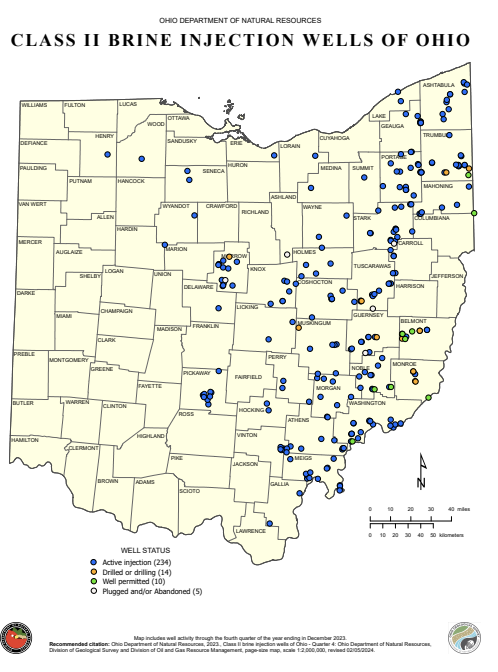
ODNR has declined to say how much injection well activity is occurring statewide on an annual basis. It also declined to make Oil and Gas Chief Eric Vendel or Underground Injection Control Program Manager Kenny Brown available for an interview.
However, after this story published on Thursday, an ODNR spokeswoman said that in the first quarter of 2025 alone, the industry reported it had injected 310 million gallons of liquid fracking waste in Ohio. For a sense of perspective, that’s at least 470 Olympic-sized swimming pools.
Looking to the Statehouse and courthouse for help
The Bobs have grown increasingly outspoken on the issue in different arenas.
In Washington County, they filed lawsuits against a spread of injection well operators. That list includes Deeprock Disposal Solutions, which owns injection wells along the Muskingum River not far from the Bobs’ acreage. The lawsuits name Deeprock as well as its former CEO, Brian Chavez, who is now the chair of the Energy Committee in the Ohio Senate.
In May, the Bobs drove to the Statehouse in Columbus to tell their stories to lawmakers, who were considering legislation to give Ohio regulatory control over a potential new form of injection wells designed to house carbon dioxide, another industrial waste.
Weeks later, both Bobs addressed the community meeting at the water association’s offices before giving reporters, activists and a lawmaker a tour of some of their flooded oil wells.
“They ruined our wells,” Bob Lane said at the meeting. “[But] my biggest concern is, I’ve got some great-grandchildren now, I look into their faces and I think, ‘What in the world are you gonna be drinking if something isn’t done about this?’”
State regulators say seven injection wells have leaked since 2019
The oil well owners’ clearest evidence of a problem comes from ODNR and the seven wells it says leaked brine.
The Redbird #4 injection well in Washington County began operations in November 2018. About a year later, ODNR determined that some of the 4.2 million gallons of brine injected at that point had migrated to 28 different production wells, mostly owned by the Bobs, some as far as five miles away.
Instead of ordering the owners to suspend operations, ODNR allowed them to modify their permit and inject into a different rock formation and depth. The well is currently active.
Nearby in Noble County, brine began showing up in oil wells near two injection wells owned by Deeprock Disposal Solutions. The first known occurrence was in 2010, about 1.5 miles away. It happened again in 2013. It got worse in both 2019 and 2021, when ODNR documented “uncontrolled” streams of brine coming from production wells up to five miles away from the injection site, causing a hazardous and expensive mess.
“The uncontrolled brine release continued for days until a plug could be set in the well,” ODNR’s oil and gas chief Vendel wrote in a suspension order about the 2021 spill. “The land surface and adjacent stream were impacted by the release. This release caused environmental impacts. The Division incurred costs of $1,279,608.03 to take corrective actions.”
The last straw for Deeprock came in 2023 when an ODNR inspector received a report that brine was “spraying from a hole” in the casing of a production well. The regulators determined that the volume and pressures of the brine flows don’t occur naturally and could only be coming from injection wells, and Deeprock’s were the only possible culprits given the volume of brine and timing. Thirteen years after the first report of a flooded production well nearby, ODNR ordered that Deeprock halt injections at its two wells.
“This spraying brine caused imminent health, safety, and environmental risk,” Vendel wrote in a suspension order.
Not far away in Athens County, ODNR in 2023 shut down three injection wells owned by Kansas-based Tallgrass Energy. That occurred after a production well owner reported in 2019 that his 30-year-old oil well suddenly stopped giving oil and instead started to spit out “100 barrels of brine in 90 minutes until it was shut in,” Vendel wrote in a suspension order.
Less than half a mile from the banks of the Hocking River in Athens County, an injection well operated by Reliable Enterprises of Ohio, a subsidiary of a Texas company now in receivership after the U.S. Securities and Exchange Commission accused it of business fraud, was ordered to halt operations in 2023 after ODNR determined it had flooded out five production wells nearby.
That entity no longer has money to maintain the wells, according to J. Tyler Wampler, an attorney for the receiver in charge of divvying out what’s left of the company. He said the receiver agreed to “give” the well to the ODNR to join its orphan well program, meaning taxpayers will carry the cost of plugging it. ODNR spokeswoman Karina Cheung said the agency doesn’t own the well, but acknowledged that the agency will have to plug it after having “exhausted” enforcement options against the original owner.
In some cases, operators have convinced ODNR to grant them new injection well permits despite problems with their old ones. For instance, ODNR granted a permit to the Redbird #5 well in 2020.
“Suspending the operation of a well or wells owned by a company does not result in an automatic denial of future applications from that company,” Chow said.
A powerful politician and his natural gas empire
Despite ODNR’s suspension order against Deeprock’s injection well in Noble County, the agency recently granted a permit to the company to drill the American Growers #4 well in Washington County.
Local anger about the new permit led to 150 people – by Buckeye Environmental Network’s count – showing up to an April 26 community meeting about injection wells in Washington County. The meeting was organized by the Warren Community Water and Sewer Association. As Bev Reed of the Buckeye Environmental Network notes, that new Deeprock injection site is just four miles from Warren’s water wells and about 2.5 miles from Marietta’s.
Once operational, it will be Deeprock’s ninth injection well, spread between Washington, Noble and Athens counties, according to ODNR records.
Until last year, Deeprock Disposal Solutions was led by Brian Chavez, now a state senator representing Washington and Athens counties. According to the financial statement he filed in May with state ethics officials, he receives income from Heinrich Production and Reno Oil and Gas, which together own hundreds of oil wells in the region. He reported 15 different income streams last year, mostly from the oil and gas industry, plus about 90 separate investments each of at least $1,000.
He was appointed to his Senate seat in late 2023 before winning his own four-year term in the general election in 2024.
After ODNR accused two of Deeprock’s wells of leaking and causing a spill at a nearby production well that cost nearly $1.3 million to clean up, the agency didn’t ask Deeprock or Chavez for the money. Instead, the agency sought it from the owner of the production well, which had sat idle for some time. State officials rejected an appeal from that idled well’s owner, who said Chavez or Deeprock should pay to clean up the mess.
Chavez heads committee that oversees natural gas and injection well policy
Most state legislation affecting the natural gas extraction, generation, or waste disposal indus tries would run through the Senate Energy Committee that Chavez controls. This year, he played a key role negotiating an overhaul of Ohio’s energy rules. House Bill 15 reduced the property taxes that any new natural gas generation plants would pay, a key plank of a package of ideas designed to spur natural gas generation in Ohio.

More gas generation plants mean more demand for the gas Chavez’ production companies sell. And if that demand leads to more fracking, that means more demand for the wastewater disposal that Deeprock’s injection wells could provide.
“If you put Ohio, Pennsylvania and West Virginia together as a country, it would be the third biggest energy producer in the world,” Chavez, who looked on as Gov. Mike DeWine signed the bill, said in a news release the governor’s office sent out. “We have the supply and the technology to power the grid for all of our future needs.”
Chavez declined an interview request or to answer written questions. In a brief conversation before a Senate floor session last week, he indicated skepticism about injection wells posing any risk to public drinking water sources.
‘Someone, somehow caused wastewater to damage their wells‘
Before ODNR issued a wave of suspensions of injection wells in 2023, the Bobs had had enough. They marched into the Washington County Court of Common Pleas in May 2022, filing separate civil lawsuits against the owners of 12 nearby injection wells.
The Bobs’ allegation is simple, yet severe. The “sizable scope” of wastewater injection underground and the “resultant, large-scale contamination and/or pollution of Ohio’s gas and oil reservoirs” has interfered with their property rights, they wrote.
All the defendants asked Common Pleas Judge Linton Lewis Jr. to dismiss the two cases against them. The Bobs, they argued, never proved that any specific injection well flooded their oil wells.
Lawyers for the Redbird injection well’s operators say the Bobs’ allegation took ODNR’s finding about a single injection well and used it, without explanation, “as the basis for a wildly speculative allegation: that every Redbird injection well caused damage to all of the other oil and gas wells and thousands of acres in two counties.”
Tallgrass Energy accused the Bobs of filing a “shotgun pleading” – painting with too broad a brush. After all, plenty of undisturbed oil wells and other injection wells sit between the Tallgrass operations and the Bobs’ wells. Maybe they flooded the Bobs’ wells.
“They simply allege that someone, somehow caused wastewater to damage their wells,” Tallgrass’ lawyers wrote.
Lewis agreed with them and dismissed most of the defendants. However, Ohio’s 10th District Court of Appeals reversed that decision late last year, effectively reviving the lawsuit.
The panel of appellate judges said the Bobs plausibly alleged that the injection wells contaminated the oil wells in the area. And they found enough to warrant joint and several liability, meaning all the injection wells could be on the hook. The injection wells have appealed to the Ohio Supreme Court, which accepted both cases.
ODNR has no plans to help. Chow said that the agency’s jurisdiction “does not extend to recovering damages on behalf of private parties who may have been impacted by injection well owners.”

‘We should be shutting it down’
Amy Townsend-Small, a professor of environmental science at the University of Cincinnati, said what’s happening in Ohio has been seen before in the Permian Basin of Texas, where Southern Methodist University researchers recently found that fracking wastewater traveled 12 miles underground before bursting through the surface at a plugged oil well.
“There’s just so much pressure under the ground because of all this brine injected,” she said.
ODNR should investigate the well owners’ reports of flooding, said John Stolz, a professor in the Department of Environmental and Energy Engineering at Duquesne University. He said regulators have grown far too lax about the industry shooting more and more waste at higher and higher pressures into the earth.
“As far as these state agencies are concerned, they see themselves more as the permitters and less as the regulators,” he said.
Ted Auch, midwest program director for FracTracker, a website publishing data and mapping on fracking operations in Appalachia, said he’s not surprised to hear about the oil men’s complaints. The more well holes you poke in the ground and the more pressure you apply, the more wells will “communicate.”
He said ODNR lacks the bandwidth to properly regulate the industry.
“When you start to get this communication, there needs to be a pause on injection until we can answer some of these questions,” he said. “There is something amiss down there, We should be shutting it down.”
What do the injection well owners say?
While the industry operators have fought the Bobs in court, none responded to media requests through the companies or their lawyers.
A phone number listed on ODNR’s documents associated with Redbird Development Company is no longer operable. Tallgrass Energy didn’t respond to written questions.
J.D. Drilling Co., and its namesake James Diddle, both named in the Bobs’ lawsuits, didn’t return a voicemail. The company’s website is dead. Its Facebook page hasn’t posted since August 2020, when it listed its two injection wells cited in the lawsuits as “for SALE!!”
Reliable One Ohio, owner of an Athens County well that ODNR said was leaking brine, listed in its business records the corporate address of Reliable One in Texas. The SEC in 2023 sued the company, accusing its officials of raising about $34 million from investors based on false claims about a face mask that could purportedly prevent transmission of COVID-19. The officials settled without any admission of guilt and the company is now in receivership.
Questions about the lawsuit against Deeprock were left with a receptionist at its offices in Marietta.
The neighbors have concerns
Marty Isner has been in the trucking business since 1954. Through much of that time, he kept his house and his garage heated with oil from the Isner 2 and the Buckhorn wells on his property.
Since Deeprock started injecting from a well less than a mile from his garage, his wells stopped giving oil and only turned up brine.
“It’s just a matter of time before that brine gets into a drinking water source,” he said. “It’s not if, it’s when. Then what’s going to happen? It’s a lot bigger deal than people realize.”
Most his anger centered on Deeprock given his proximity to the well, and perhaps the political power of the company’s former CEO. He called it “bullshit” that ODNR gave Deeprock a new permit given the ongoing production well problems.
“Something is going to happen one of these days,” he said. “Where is all this water gonna go when there’s an accident down there, 50 yards from the river?”
Two other well owners from the Marietta area said in interviews they’re getting the same flooding problems.
In 1952, Joe Wigal’s great grandfather drilled a well on his property, he said at the community meeting. He added that these days all it can produce is brine. He showed up with two jugs full of the stuff – one he wanted tested to trace its origins, and one he wanted to personally present to Chavez.
Austin Wilson said he can still salvage some oil from his private well, but that benefit is outweighed by the cost of properly disposing of the dozens of barrels of brine that come with it.
He frets about the financial liabilities of his well, but his worries are more existential.
“That’s the bigger concern,” he said in an interview. “It’s not going to be much longer until it gets up into that drinking water.”
This article was updated to reflect a corrected quotation from Beverly Reed on the distance between injection wells and water wells in Washington County.